Alexander’s Immigration Story
Tell us about your family’s roots.
My family is from the Philippines. The paternal side of my family has their roots in what is now Mandaluyong City in Metro Manila. The maternal side of my family has their roots in the provinces of Laguna and Negros Occidental. I was born in Santa Mesa, a district of Manila.
What is your family’s migration story?
The Military Bases Agreement of 1947 allowed the United States to recruit Filipino nationals to the United States Navy. My dad enlisted in 1980, and I was born in 1981. Dad was stationed to San Diego, and my mom and I followed him in March 1982.
Mom and I spent a good amount of time going back and forth between Manila and San Diego, especially when dad was out at sea. For most of my life I’ve felt like I’ve had a foot in two very different cultures, languages, and value systems. This identity as a bridge has formed my sense of empathy and still informs the way I navigate life and work today.
In 1992 Dad became a United States citizen, made possible by the Armed Forces Immigration Adjustment Act of 1991. I didn’t naturalize until 1996, and mom naturalized a couple years after me. The rebellious 14-year-old that I was honestly resisted becoming a US citizen. I thought I would lose a huge part of my identity by naturalizing. What I realized was that my identity was already a tapestry of threads woven together from both cultures.
What’s one memory, story, recipe, or item you and your family have carried with you?
Food plays a significant role in my culture, as it does for most immigrants. Every dish I cook connects me to my family, my ancestors, my people, and our collective history. My maternal grandmother lived with us in Virginia for a significant stretch of my youth and teenage years. I spent a lot of time in the kitchen with her taking in all the smells and learning all her tips for making our family’s favorite dishes. Her spirit lives on through me when I cook adobo, pancit, or kaldereta. I get to share her story when I cook for others.
My mom, renowned as a great cook by our family, visited me in Omaha a couple years ago and I made her adobo one evening. I’ll never forget her telling me, “”Baka ikaw nag mana sa lola mo.”” (“”Perhaps you’re the one who inherited this gift from your grandmother.””)
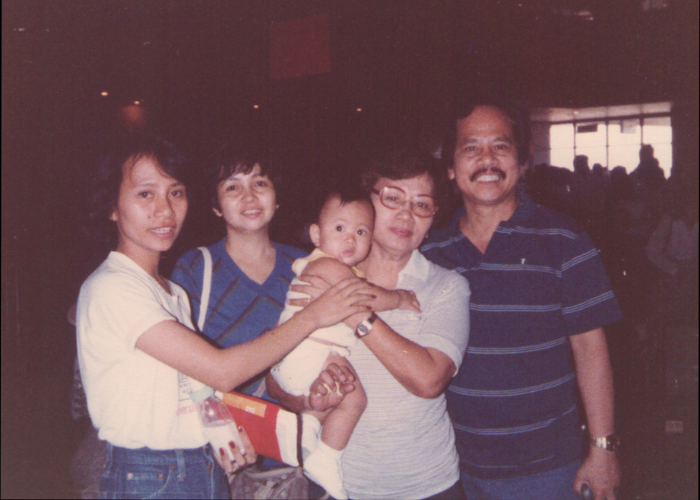
A note on the photo I attached: From left to right it’s my mom, my paternal grandmother, my maternal grandmother holding me, and my maternal grandfather. The whole family was seeing me and mom off at the airport as we embarked on our journey to the United States.

To empower immigrants and refugees to live confidently through high-quality legal representation, resettlement, and social work and to create welcoming communities through education and advocacy.
Quick links
Newsletter sign-up
We are a 501c3 nonprofit. Our EIN number is 74-3195841. The information contained in this website is provided for informational purposes only and should not be construed as legal advice on any matter.
Copyright © 2026 CIRA. All Rights Reserved.